Remote Ingest and Autonomous Operation: IN2IT Access
Streamline news workflows with IN2IT Access. The ultimate solution for remote video ingest and autonomous operation.
Remote Ingest and Autonomous Operation: IN2IT Access
Modern broadcast production and news workflows require journalists and editors to operate from anywhere in the world. To achieve this immediacy, TV networks and production companies must solve a fundamental technical challenge: how to transfer, process, and organise media quickly and without manual intervention.
The answer to this technological challenge lies in video ingest automation and the implementation of remote, autonomous ingest platforms.
What is video ingest automation?
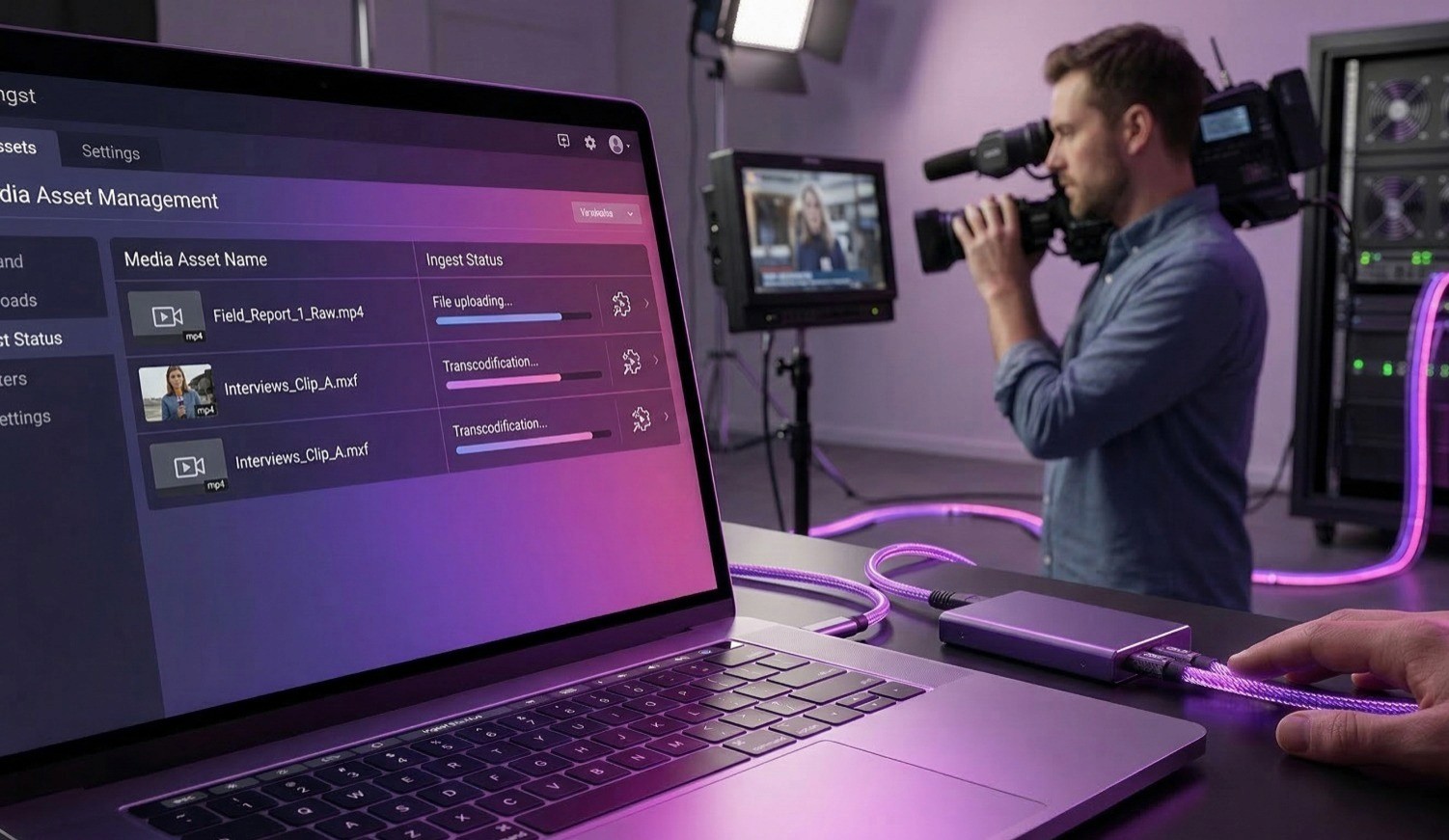
Video ingest automation is the process by which specialised software captures, transcodes, transfers, and tags audiovisual media without a human operator needing to perform each step manually.
Professionals researching how to automate video ingest workflows are looking for solutions that eliminate technical bottlenecks. An advanced automated system allows for:
Instant indexing: Automatic extraction and mapping of metadata from the source device to the media asset management (MAM/PAM) system.
Background transcoding: Autonomous conversion of media into the network's editing formats (mezzanine) or low-resolution proxy versions.
Smart routing: Automatic delivery of files to the appropriate servers based on rules predefined by the newsroom.
The best platforms for ingest automation: The role of IN2IT Access
When searching for the top platforms for managing news content, the industry demands user-centric tools that do not require advanced engineering knowledge.
IN2IT Access, developed by Woody Technologies, is positioned as a leading solution for remote broadcast ingest. Its architecture is specifically designed for autonomous operation:
Web browser-based interface: Journalists do not need to install heavy software on their field equipment. They access the platform via a browser to search, preview, and select media (camera cards, local drives, or mobile devices).
Accelerated and secure transfer: While the journalist continues working, IN2IT Access manages the upload of content to the broadcaster's central servers, ensuring data integrity even over unstable connections.
Invisible processing (Autonomous Operation): Once the user selects the clips, the IN2IT engine takes full control of the transcoding, packaging, and delivery operations, freeing the operator from any technical tasks.
Comparison: Traditional Workflow vs. Automated Workflow with IN2IT Access
Process Stage | Traditional Manual Ingest | Autonomous Operation (IN2IT Access) |
Media access | Requires physical ingest stations in the newsroom. | Remote access via web from any location. |
File processing | Manual conversion using third-party software. | Native, automatic transcoding at source or destination. |
Metadata | Manual entry prone to errors. | Automatic rule mapping and preservation of original metadata. |
Availability | The editor must wait for the entire process to finish. | Edit-while-capture functionality (editing during transfer). |
Broadcast Interoperability: Why it is crucial
To streamline editorial workflows in digital environments, ingest software cannot operate in isolation. This is where broadcast interoperability comes into play.
Interoperability is the ability of different platforms (hardware and software from various vendors) to communicate and exchange data seamlessly through standard APIs.
Platforms like IN2IT Access stand out because they integrate natively with the market's leading non-linear editing (NLE) systems, such as Avid Media Composer or Adobe Premiere Pro, as well as storage and orchestration systems. This ability to connect field environments with central infrastructures (whether on-premises or cloud-based) is what enables true, frictionless remote production.